Tuesday, 6 September 2011

Anoushka Athique's Fabric Walk: A Personal Response


Arthur Berry wasn't a great supporter of urban renewal. In his famous lament for the lost pubs of Burslem the artist, playwright and broadcaster  speaks fondly of gaunt, dark  buildings discoloured by years of wet smoke and complains that nothing has been the same since they were knocked down. Travelling though the Potteries today  it's impossible not to share a little of Berry's nostalgia as entire neighbourhoods disappear from the map. Following years of  decline no-one would deny that change is overdue but  regeneration was never going to be painless and this conflict is reflected in an art project currently underway in the city.

Place, Space and Identity was initially conceived as part of the RENEW North Staffordshire programme with the aim of bringing creativity to the area's urban renaissance and extending the opportunity for participation in the arts . In its third phase it is overseeing public art projects in a number of areas designed to confront our industrial heritage and provoke discussion about the future aspirations of the city. One of these areas is Middleport.


Over the past weeks Anoushka Athique has been carrying out repairs to clothing in return for residents memories. Taking these stories as a starting point her intervention into the urban landscape takes the form  of a route wrapped in fabric around the streets and parks of this once thriving community . Before continuing I must declare something of a personal interest here. My parents grew up in Middleport and so did their parents before them so perhaps I might add a few memories of my own as we follow the Fabric Walk.


Like many journeys it begins at a station before continuing  alongside the long closed Railway pub and already I find myself scanning the landscape for the distinctive purple fabric that will guide my next step. Crossing the road I pass another  sadly neglected boozer where, in the early 80s, they served chicken in a basket  and teenage girls drank lager and black. I'm travelling back in time and heading towards the canal.


Following the wrapped tow path I'm reflecting on the role of canals as the arteries of the industrial revolution when a barge approaches causing the fabric to ripple in the swell and I'm reminded how filthy this canal was when I was a child - a foul polluted waterway full of old prams and bikes - and how much better it is today as a site for boating and pleasant strolls.  Change shouldn't  be measured solely on what we lose. We must also take into account what we gain as a result.


Crossing the partially wrapped bridge into Middleport proper  it strikes me how the experience is causing me to look at things differently. I'm no longer simply a stroller I'm attuned to the unexpected, to the psycho-geography, the derive. Once into  familiar surroundings the full impact of  the regeneration programme on the area becomes apparent. Whole streets are boarded up awaiting demolition while many have  disappeared altogether. Following the fabric adorning the railings of the park where my grandmother liked to sit I notice the dilapidated club that was once at the heart of the community. Another derelict drinking den I think to myself. Arthur Berry would not be pleased.


Anoushka Athique says one of the ideas the Fabric Walk explores is that sewing, wrapping and repairing are inherently caring and restorative actions and nowhere is this more apparent than in the lovingly wrapped individual bricks sitting on a demolition site. Equally touching is a nearby  sign bearing the name of a street that no longer exists  bandaged in the now familiar purple fabric. But it isn't only the bricks and mortar I imagine being cared for  as I look around but all  the qualities that once made up this community and which must be preserved if it is to be reborn.


For a moment I think I've reached the end of the walk but something tells me it can't end at this spot. That would be too desolate, too sad, and so I press on and it's not long before I'm back on track heading into an unexpected green space which may once have been scarred by industrial debris but was long ago returned to nature. On this early autumn afternoon there are people walking  dogs and relaxing in the sunshine and the contrast to the blighted streets I've  left behind couldn't be more pronounced.


Amid all this greenery my thoughts turn to renewal and as I head up to the highest point overlooking Middleport and Berry's beloved Burslem I'm reminded once again of his opposition to change. If he'd had his way the Potteries would have remained the dirtiest city on the planet to which, he imagined, tourists would flock to marvel at  the soot and the grime. Well that was never going to happen but - in respect to Berry's generation, to the memory of my grandparents who lived and worked in these streets and to  the younger generation that will repopulate them - we must ensure that this opportunity to build a better future is not wasted.


Retracing my steps along part of the Fabric Walk I'm pleased  I took the time to explore it. There are no Reichstags or Pont-Neufs -although as we have seen there is a partially wrapped canal bridge - but these economies of scale are entirely sympathetic to the environment. What's more it demonstrates that Place, Space and Identity is fulfilling its mandate. Evidence from cities that have undergone similar transformations suggests that the arts have a significant role to play in the process, both in offering creative solutions and developing vibrant communities. Let's hope they are given further opportunities to do so in the Potteries.

To find out more about the Fabric Walk and Place, Space and Identity's other public art projects visit www.placespaceidentity.org/




Tuesday, 5 July 2011

Ceramic Cities and Victorian Nurseries

It was interesting to read Mike Wolfe's thoughts on Ai Weiwei's Sunflower Seeds in the Sentinel (June29). Writing about  his visit to Tate Modern in January Mike describes the experience of his encounter with the ten tonnes of  crafted clay seeds in the Turbine Hall and his frustration at being prevented from roaming freely through them.

This was because health and safety officers had  raised concerns about the levels of dust generated by visitors tramping over the unglazed seeds. Mike isn't alone in  his disappointment at being unable to experience the work as  Ai Weiwei intended but his proposed solution  is certainly unique. Given that the  seeds were produced in Jingdezhen - the centre of Chinese ceramic production -he thought it would provide an excellent marketing opportunity if a Stoke-on-Trent manufacturer offered to glaze the seeds and thereby solve the problem.

Made in Jingdezhen. Ai Weiwei and his Sunflower Seeds

Despite his best efforts the idea was ignored which is a shame because even if the offer was rejected (as, I suspect, it would've been) it  could only have benefited the city to be associated with such a talked about work of art and its newsworthy creator. It would also have provided a topical introduction to the current exhibition at the Potteries Museum exploring the links between  Jingdezhen and Stoke-on-Trent.

Given their shared industrial heritage it's unsurprising that visitors have long commented on the similarities between the two cities - Mike Wolfe recalls being reminded of Burslem and Longton when he was part of a North Staffs delegation in 2003 - but while the two cities are at the heart of the story it has a fascinating sub-plot. Spanning centuries of ceramic history the show explores a dialogue between east and west driven by trade, fashion, etiquette, social values and technological change.

Picture: Potteries Museum

Alongside many Chinese originals  are examples of early adaptations by local potters which, along with a little 18th century industrial espionage, would eventually lead to the development of bone china at the end of the  century. This breakthrough saw Stoke-on-Trent rival Jingdezhen in terms of quality for the first time which, combined with increased import duties, saw a decline in Chinese wares on the domestic market.

In addition to this story of porcelain and chinamania visitors are also treated to a little Arts and Studio pottery featuring rarely seen examples of 20th century ceramics from figures including Bernard Leach and Hamada Shoji. There's also a section looking at cross-currents in contemporary design.

While given the time scale in question the displays may be a little on the modest side a more generous way of looking at it would be to say the exhibits have been carefully chosen to illustrate the narrative. This  aside, for anyone with an interest in ceramic design, the exhibition is certainly worth a visit. It's just a shame it doesn't include a handful of glazed sunflower seeds. Ceramic Cities continues until September 4 and, I'm pleased to say, admission remains free.

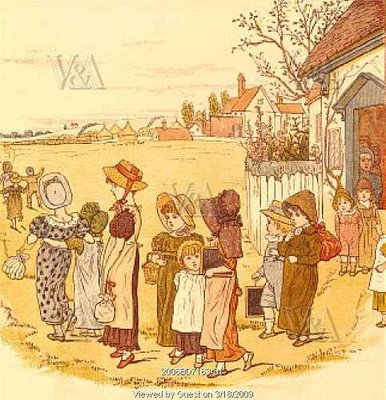
Children occupied an ambiguous position in Victorian society. While many endured Dickensian  exploitation childhood was idealized in art and popular culture. This idealization is no more evident than in the illustrated nursery books pioneered by publisher Edmund Evans during the late nineteenth century.

The founding fathers of the  genre were Walter Crane and Randolph Caldecott. Utilising new wood block printing techniques Evans was able to mass produce their work at prices which had previously been unaffordable to many families, establishing a style that would remain influential for decades to come. In the case of both Crane and Caldecott this was only one aspect of their practice. Crane in particular enjoyed a varied career as a leading figure in the Arts and Crafts Movement but, nevertheless, took his work for children very seriously.

School's Over. Kate Greenaway. 1879. V&A Images

 Illustrations by both men, along with a smaller number from popular rival Kate Greenaway,  (who in a somewhat unwholesome example of  Victorian ambiguity was encouraged by the brilliant but flawed John Ruskin) can be seen in Magic of the Nursery at Leek’s Nicholson Gallery from July 9 to September 3.

Parts of this post originally appeared in the Arts Scene column of the Sentinel Friday June 24 2011

Monday, 27 June 2011

Heard the one about the Painter and the Pistol?

Hidden Paintings of the West Midlands

Once upon a time we knew what to expect from the BBC. While  entertainment  naturally dominates  the schedule there's always been a place for programmes in which  someone who gives the impression they know what they're talking about leads the viewer on an educational journey. Sadly these programmes are becoming a rarity.

Not content with foisting the lazy opinions of comedian David Mitchell  on the nation on Thursday's Question Time the beeb, last night, gave us an arts programme fronted by another comedian Nick Hancock. Now Mr Hancock seems like a nice chap and we all know he's a passionate Stokie but do these qualities  make him the most suitable person to send in search of the Hidden Paintings of the West Midlands?

From the outset things didn't look good. 'This is a programme about art' our host began before reassuring the viewers - who he must've feared were already deserting in droves - that he's not Brian Sewell. No kidding. What next, Alan Carr on the saucy secrets of the San Marco frescos?  Harry Hill explaining the overlooked slapstick in the paintings of Caravaggio? It's a thought but  let's see where Nick Hancock begins his journey.

Surprise, surprise it's at the Britannia Stadium. Now this may be a Premier League arena with the loudest fans in the land  but, as far as I'm aware, it's never been associated with the arts. The excuse for this barely disguised love-in between Old Nick and Saint Peter, it transpired, was to take a look at what the Stoke City chairman described as a historical record of our industrial heritage. This turned out to be a fairly ordinary landscape and, unfortunately, it set the tone for what was to follow.

After a quick dash down the canal to Middleport it was off to the Black Country to examine some of the earliest images of the industrial workplace. These were dealt with in short shrift before two ex- steelworkers were given the opportunity to reminisce about the conditions they worked in. That they belonged to a completely different era to that being discussed didn't seem to matter and, anyway, steel was quickly dismissed in favour of the motor industry. Sadly Mr Hancock wasn't able to come up with many hidden paintings to illustrate his point (ie that cars were once manufactured in the Midlands) so it was back to the Potteries.

Here things began to get interesting - particularly for  viewers fond of those true crime programmes that occupy the schedules of certain TV networks - and, once again, why wasn't I surprised? The paintings Mr Hancock had come to discuss were by the Edwardian  artist John Curry who had a torrid affair with their subject, Dolly Henry, before shooting her dead and ending his own life in 1914.

Curry, we learn, worked for Minton before securing a place at the Royal College of Art leaving behind a wife in Newcastle-under-Lyme.  He was 'utterly enslaved' by Dolly, we're told, even declaring his love for her with his dying  breath. One suspects  this tragic tale of domestic violence, murder and suicide was always going to be central to the programme but it's a shame it rarely rose above the level of a bad joke the punchline of which was 'He should've stayed at Mintons.'

Not Included. Dudley. JMW Turner. 1832. Lever Gallery

The show closed with a man perched precariously atop a converted camper van painting the post-industrial landscape of the Black Country. Once again we were told it was a historical record - which is more than can be said for the programme itself. Where's Arthur Berry? I wondered. Where's Reginald Haggar? Where indeed is Turner's famous painting of Dudley Castle? OK it's not hidden and it isn't in the West Midlands but surely a painting of a town in the throes of industrial change, once described by  Ruskin as a 'clear expression of what England was to become,' deserved some kind of attention. Sadly not because Hancock, let's not forget, isn't Brian Sewell.


Monday, 13 June 2011

Staffordshire University AMD Show 2011

Show and Tell

Dr Astrid Herhoffer says she’s proud to lead a faculty where talent is nurtured and encouraged to grow. On the evidence of this year’s Arts, Media and Design show she has every right to be as, once again, Staffordshire University demonstrates the potential of art to surprise, inspire and transform lives.

From the outset the surprises come thick and fast provoking a range of responses. On the one hand there’s the restrained beauty of Margit Kiviniemi’s  painterly surfaces that appear to have rusted and the towering grandeur of Heather Silcock’s billboard-sized urban fox.
On the other hand there’s something  sinister about the text that is etched, filed and framed in Stacey Booth’s piece Welcome to the Wonderful World which plays on our willingness to share even the most personal thoughts on social media networks. Similarly unsettling is  Kristy Styles’ domestic chiller, La Maison Etrange,  which bristles with the kind of menace you might expect from David Lynch.

Debbie Mills with her exhibit Innocence. Photo by Horace Wetton

There’s also pathos and humour to be found. Debbie Mills’ childlike den, looking sadly abandoned, invites the viewer to crawl inside and hide from the crowds. Nearby, Rachel Bradley may be in the frame of her video projection but she’s also hiding –in this case masquerading as Ziggy Stardust – in a performance that’s both amusing and oddly affecting.

Elsewhere there are collapsing skyscrapers and chairs that appear to be climbing the walls but there’s much more to this comprehensive exhibition than fine art. With strong showings from across the faculty, ranging from textiles and ceramics to graphic design, I’d urge visitors to set aside the time to take it all in.

Of particular note is the Photography display. Among a hugely impressive offering two to look out for are Matthew Basham and Daisy Harper. Basham’s visceral work displays a streak of Surrealism while Harper’s sumptuous colour images exquisitely capture the fluidity of dance.

For all the departing students represented in the show this is the culmination of an exciting journey and the beginning of a new one. It’s been well documented in recent months that these are difficult times for the arts but lecturers Ian Brown and Sarah Key are confident Staffordshire University is prepared for the challenges that lie ahead. So too, you’re left feeling, are today’s talented graduates.       

The Art, Media and Design Show 2011 continues at Staffordshire University’s College Road campus until June 18.
A Version of this post originally appeared in the Sentinel Monday June 13 2011

Tuesday, 7 June 2011

Reprieve for Stoke Museums

But What Does the Future Hold?

Visitors to the Potteries Museum will welcome the news that Stoke-on-Trent City Council has postponed the introduction of admission fees to the home of the Staffordshire Hoard. Since February £7,500 has been received in donations from the public prompting the council to delay the introduction of the controversial charge until after the summer.

Announcing the decision cabinet member for economic development Mark Meredith said "We have been receiving donations, although at a level that is slightly below what we were  hoping for, but we are approaching our busiest time at the museum. We are therefore looking at extending the donation period to see if donations maintain their success with a view to continuing with our preferred option of keeping the museum's admission free."


This is good news as is the report that the campaign to save Etruria Industrial Museum, symbolized by 9 year old Jack Fowler-Evans, has been given more time to explore the possibility of creating a body to run the important heritage site. Speaking on this subject Councillor Meredith said it was "inconceivable" that the museum could close. So what happens next?

Well, as we have heard from the former elected mayor, the council's "preferred option" is to continue with the policy of free admission at the Potteries Museum and he personally considers it "inconceivable"  that we could lose an asset such as Etruria. This will be reassuring to many people but what trust should we place in the words of a man whose political journey led him from the Militant Tendency to the leadership of a bizarre coalition that brought only deadlock when the city needed direction?

Compare his statements from 2007, when announcing ambitious plans for city centre regeneration, with those of last week when the council embarrasingly scaled down the proposals to little more than a 60 minute makeover. Given these facts, along with the flip-flops during  his period in office, it should come as no surprise that questions are already being raised about the long-term feasabilty of the council's commitment.

Martin Tideswell, writing in the Sentinel believes the postponement of admission fees is only delaying the inevitable and goes on to argue that cultural attractions need to market themselves more successfully. While I'm not sure about  his suggestion that the Potteries Museum should celebrate the achievements of the likes of Robbie Williams and Phil 'The Power' Taylor  there is some merit in his thinking given the wealth of heritage in the city that is often overlooked.

These are difficult times and the coming months will prove crucial in determining the city's relationship with its  cultural assets. Yes we need to look at how we promote ourselves and see if this can't be improved but at the same time we must remind those in elected office that the city's heritage belongs to us and must be preserved for youngsters like Jack Fowler-Evans to pass on to the next generation. Are you listening Comrade Meredith?

Wednesday, 25 May 2011

Keep The Potteries Museum Free

Say No to Admission Charge

Stoke-on-Trent City Council hopes to raise £73,000 by introducing an admission charge at the city's  museum. Claiming that it can no longer afford the annual cost of keeping the museum open the council intends to scrap the principle that museums should be free for all.


Supporters of the museum engaged in a campaign to raise enough money to avoid the introduction of the charge have collected £5,000 but this will not be enough. Unless more can be raised the council will introduce the £2.50 fee on June 5.

For many people, in what is frequently described as one of the most economically deprived areas in the country, this could prove to be the date the museum ceases to be a significant factor in the cultural life of the city.

This would be a great shame because the museum's collection is part of our heritage. Charging visitors to view the world class display of ceramics - which, let's not forget, was designed and produced by our  ancestors- would be like introducing a levy on the family silver.

The new council, a Labour Council to paraphrase Neil Kinnock, must look into this proposal urgently. Excluding anyone from culture on economic grounds is not only unfair it is unacceptable in a civilised society.

Perhaps they should take note of the words of William Morris who said he didn't want art for a few anymore than he wanted education for a few or freedom for a few.  But then William Morris was a man of principle.


Tuesday, 29 March 2011

Ceramics by Halima Cassell

Dreams Made Manifest

Anyone bringing ceramics to these parts should be prepared for a friendly reminder that we have more then enough clay beneath our feet. Not that Halima Cassell has anything to fear. The Blackburn artist’s eye catching work ensures she’ll never be accused of carrying the proverbial coals to Newcastle.

As recently noted in Art Daily ceramics is once again making an impact on the international scene as a new generation of artists breathes life into the centuries old material. Having exhibited extensively both in the UK and internationally Pakistan born Cassell’s latest collection, fusing history and tradition with contemporary flair, is her biggest solo show to date.  

Blurring the line between raw material and finished work she prefers to leave her ceramics unglazed allowing the clay to provide the colour while the interaction of light and shadow on the deeply carved surfaces adds a sense of drama to her multi-faceted dish-like forms.

Unsurprisingly the influence of her Asian background is evident throughout but so too is a fascination with the artistic heritage of other cultures ranging from African design to Neo-Gothic architecture. Traces of Modernism in the shape of Hepworth, Modigliani and naturally Brancusi are also apparent.

Perhaps less obvious yet equally interesting are subtle shifts between organically feminine forms and robustly masculine ones. This playfulness appears to be a feature of Cassell’s work - a mixture of the structured and the fugitive - a fusion of parallel planes and flowing lines.

Alongside Cassell’s trademark ceramics are recent pieces in other materials – stone, wood and most notably bronze (and here the ghost of Brancusi looms largest) - pointing towards a diversification of her practice and a growing concern with sculptural form.

This exhibition deserves to be seen in North Staffordshire. The days of large scale pottery manufacturing may be over but with so many of us able to say ‘my grandmother was a ceramic artist’ Cassell is guaranteed to find a discerning audience - just don’t expect any cups and saucers.

Halima Cassell: Dreams Made Manifest continues at Newcastle-under-Lyme Borough Museum and Art Gallery until May 8.

A version of this post originally appeared in the gO supplement of the Sentinel 25.03.11

Friday, 11 March 2011

Lament for a 1970s Record Shop

Twenty years ago they were an important part of our culture and community with over 2000 of them to be found on High Streets up and down the country. Today new technology and changing consumer habits have made them a rarity with another one closing every week. I’m talking about independent record shops of which, according to a recent book by Graham Jones, there are now less than 300 remaining.

To anyone for whom Nick Hornby’s High Fidelity strikes a chord this is a sorry statistic. Much of my youth was spent in these places rummaging through racks of alphabetically arranged and beautifully packaged vinyl, donning headphones to listen to some obscure American garage band while anticipating the thrill of getting it home, dropping it on the turntable and whacking up the volume.

There are many long vanished favourites I could mention, recalling in obsessive detail which classic single or groundbreaking album I first discovered in each but there’s one in particular I want to discuss both for the fond memories it inspires for being the first of its kind I fell in love with and because the more I think about it the more surprising it seems that it ever existed at all.

The first surprise is its location. Porthill View is a terraced street well outside the town centre which in the 1970s was dotted with barber’s shops, butchers and newsagents. Further along an eternally optimistic aunt sold wool from a drab establishment that was always teetering on the edge of going bust until one day it did. There may even have been a pet shop. Some of these businesses survive today but not the one where I spent my pocket money. Curiously winter evenings feature in the bulk of these memories. Headlights piercing the  after-school gloom, the glow from the window illuminating wet paving stones and reflected in frozen puddles, as though the sun never shines on Porthill View. Which of course it did and does.

Leaning my bike against the wall I push open the door and step into the familiar warmth where I discover the second surprise. Instead of finding a young man, long hair swaying back and forth as he nods along to Deep Purple or Led Zeppelin, a silver haired old lady slowly makes her way out of the back and takes her position behind the counter. The lads at school call her Mrs Sharples but I’m not convinced this is her name. Above her head album sleeves it’s difficult to imagine her being familiar with are pinned to the wall - Ziggy Stardust, Dark Side of the Moon, Transformer. Next to the tiered record racks stands a revolving cassette display that squeaks as it turns.


Most of the time I’m alone in the shop and exchange no more than a polite smile with the old lady but on other occasions gangs of older kids, trailing a cloud of patchouli and cigarette smoke, descend noisily on the premises. The boys are wrapped in Afghan Coats and fading denim while the infinitely better dressed girls flaunt sprayed on bell-bottoms, polo-necks and orange cork platform sling-backs. On these occasions, like a benign bird of prey, the old lady’s eyes follow every move the intruders make as they rummage through boxes of ex-chart 45s with a disinterest I don’t yet understand.  Naturally they ignore me and I don’t say a word.

On the day the new chart is announced on the Radio 1 lunchtime show I watch the old lady arranging the top twenty display on a notice board with tiny holes into which she presses molded plastic letters. Sometimes they don’t fit properly or there are characters missing. It takes her a long time. Although the suppliers  provide ready printed versions these days she prefers to do it this way. It’s what my customers  expect she says.

Tiger Feet, Rubber Bullets, Teenage Rampage - Bohemian Rhapsody, 48 Crash, Waterloo.  These are just a few of the hits that make it onto the board. One day I ask for Substitute which has been re-released and made the charts. She shows me something that looks like an LP explaining it’s one of these new 12” singles and I should play it at 45rpm. It has I’m a Boy and Pictures of Lilly on the B side. It’s the latest fad she tells me slipping it into a plain paper bag.  Next come the Beatles and the Kinks and a profound regret for having missed out on the 60s, which a bookish neighbour tells me  were  laden with so much more substance than the grey and empty 70s, but things are about to change.


Discovering Dr Feelgood I begin to outgrow the adolescent exclusivity I share with the shop and embark on simultaneous relationships with cooler, hipper outlets where I’m introduced to similar disaffected bands who like to play fast and loud. When the Sex Pistols release God Save the Queen I notice the old lady leaves the chart position blank. There’s no number two during Jubilee week, no molded plastic to upset the establishment and spoil the party. Later she negotiates her distaste for Never Mind the Bollocks by covering the offending word with a topical hand written sticker saying BUS STRIKE. This is the last memory I have of the place and it still makes me smile.

I don’t know what happened to the old lady or her shop after this but one day it just wasn't there anymore. Did I miss it? I’m not sure. As I’ve said I’d already moved on but I miss it now. I miss the way places like this became the focus of so many teenage lives and I’m sorry that so few remain. There’s no future Johnny sneered but he was wrong. It’s just that records you can’t hold in your hand are a development we could never have foreseen.

Surprisingly vinyl enjoyed the biggest growth rate of any music format last year. Enthusiasts and the curious alike should visit Rubber Soul Records in Stoke Town.  A twenty first century Independent Record Shop.

Sources
Jones, Graham. Last Shop Standing (Whatever Happened to Record Shops) 2009

Tuesday, 1 March 2011

March Diary Dates

Erasure and Journeymen

The growing popularity of museum apps, guiding visitors around many of the world’s greatest art collections, is the latest response to a thorny question facing curators in today’s image saturated world. How do you retain the attention of a contemporary audience that increasingly demands to be entertained as well as informed? 

Addressing this question raises others of course. Do museums and galleries (particularly in times of austerity) occupy the same competitive cultural space as cinemas and other popular attractions? And if you’re inclined to agree with this question isn’t there a danger that too great an emphasis on accessibility could essentially devalue the museum experience? Ultimately the question may come down to whether or not you believe it’s the role of art to entertain at all.

If these were factors in the planning of Erasure, a new media exhibition currently running at the Potteries Museum, the curators must be congratulated in having succeeded in striking a more or less perfect balance between presenting a show that is not only accessible and entertaining but avoids the traps of either shoehorning work into the theme or trivializing the content.

They are helped in this respect in that new media lends itself to this type of presentation. While there are elements that wouldn’t look out of place at a gaming expo (and this is not meant as a criticism as, here, fun is part of the appeal) the words of Walter Gropius greeting the visitor at the outset clearly set the tone of cutting-edge integration that follows.  Art and Technology – A New Unity.

There’s no doubt there’s a pleasing unity to this show and many reasons to commend it but perhaps the highest praise I can offer is to return to the initial question and say that, above all, it grabs the visitor by the collar and demands attention. Having done so it then provides a friendly pat on the back and says ‘enjoy’ and one of the most enjoyable aspects of Erasure is observing the reaction of the audience itself.

Whether sitting at computer terminals interacting with the generative art of ZenBullets, marvelling at Michael Shaw’s 3D doodles or simply getting to grips with the elusive surface of Toby Ziegler’s acrylic Je t’adore, Baby it’s a pleasure to see both adults and children (who no doubt feel they have a greater understanding than their parents) so clearly engaged with the experience. http://www.erasureexhibition.org.uk/

Similarly engaging is the work of Antti Laitinen and David Blandy featured in Journeymen at AirSpace Gallery.

Laitinen’s work pits the artist against natural elements and materials in a battle in which both he and the landscape are pushed to the limits of endurance. In a video showing on one wall a frozen lake is taken apart by a chainsaw and slowly reconstructed into a monolithic structure of ice blocks.

Another piece shows a block of ice being towed across a lake by a small boat (the same block, the same lake?)  presumably slowly melting and returning to the waters from which it was formed.

Sometimes it’s easy to pass pieces like these and then forget all about them but something about Laitinen’s work lingers in the memory and it’s more than the sound of the chainsaw echoing around the gallery.

Maybe it’s something spiritual. Or maybe it’s something to do with our attachment to the landscape and nature, the knowledge that we’ll never quite master it. The ultimate futility of Laitinen’s quest.

Blandy’s work is very different but in a way involves another kind of quest, this one a search for identity  (or multiple identities) and, he, in particular hands the initiative to the audience with an invitation to join him on his journey.

Playfully appropriating the imagery of geek culture he has created an adolescent environment populated by superheroes and avatars in which his alter ego, the Lone Pilgrim, recurs in posters, action figures and an arcade fighting game offering the visitor a choice of identities.

Further delving into the mythology of popular culture a video piece explores the legend of the Mississippi Delta Blues offering echoes of Robert Johnson and diabolical figures encountered at the crossroads after dark.

Finally, in The Child of the Atom, Blandy’s hyper-real journey concludes by considering the relationship of the Hiroshima Bomb to his own existence in a thought provoking and often moving piece of film and animation that is both personal and universal.

To compliment this exhibition AirSpace Gallery is providing the opportunity to talk informally to Blandy about his work. In Conversation with David Blandy takes place on March 12 () Admission is free. www.airspacegallery.org

Journeymen and Erasure are both organized in conjunction with the Stoke Your Fires festival and continue until March 26 and May 2 respectively.

Elsewhere a mixture of hand and machine stitched pieces from ten contemporary textile artists including the award winning Debbie Smyth opens on March 5 at the Shire Hall Gallery Stafford.  Drawing with Thread continues until May 1.

At the Chancellor’s Building Keele University the Three Counties Open Photography Exhibition continues until March 26 while at Burslem School of Art a collection of watercolours, acrylics and collages from local artist Margaret Wilson can be seen until March 18.

A version of this post originally appeared in the gO supplement of the Sentinel 25.02.11

Tuesday, 1 February 2011

February Diary Dates


Art in the Age of Digital Reproduction

When David Hockney’s iPad art was shown in Paris recently it was the tool rather than the work that attracted the greatest attention. Given our appetite for novelty this is understandable yet artists have been experimenting with computers since the 1950s while mechanical reproduction of one form or another has long been a factor in the practice and reception of art. It should come as no surprise then that this month’s featured events all reflect the impact of today’s digital culture.

Rebecca Barrs, who has had several solo exhibitions, specializes in high-speed photography. The first experiments in this field took place in the nineteenth century with the most prominent exponent being Eadweard Muybridge.

Muybridge’s technique was initially employed to discover whether the four hooves of a galloping horse ever leave the ground simultaneously. They do. Later he was able to replicate motion in a manner considered a precursor of modern cinema.

In contrast Barrs, whose latest work can be seen at Newcastle Museum, is principally concerned with freezing motion. Her digital images of dripping water appear static rather than fluid, capturing moments invisible to the naked eye with an almost sculptural quality.

It may have been better, however, if the work had been allowed to speak for itself. Instead titles referencing chance figurative associations inevitably dictate the focus the eye  - rather like someone pointing to the outline of a chicken in what you previously believed to be the abstract design of your bathroom tiles – and this is an unnecessary distraction. Liquid Art continues in the New Generation Space until March 20.

Stoke Your Fires, the festival of the moving image, begins on February 18 providing a space for the celebration of creative innovation and a forum for the exchange of ideas. The exhibition highlights include an animator in residence project (February 19-27) and Erasure, a new media exhibition, which continues until May 2. Both these events can be seen at the Potteries Museum.

Across the road AirSpace Gallery is bringing together new work by David Blandy with that of performance artist Antii Laitinen in a show themed to compliment the festival. (February 19-March 26).

Stoke Your Fires offers more than exhibitions however with a busy programme also including  a four day convention, film screenings and community animation workshops for all the family. Visit http://www.stokeyourfires.co.uk/ for further information on these and other events.

In a similar vein DATFEST, Stoke’s first digital arts and social media festival, kicks off at venues across the city centre on Friday February 25 with bITjAM presenting a Mediafail workshop at Hanley Library (2pm-5pm).

Mediafail invites visitors to take along the forgotten sounds and images we all have clogging up our hard drives and learn how to transform them into a digital masterpiece. All contributions will be recycled and used in a live audio-visual performance at Fat Cat’s Bar Trinity Street on Sunday 27 (7.30pm). Admission is free. If bITjAM's September residency at SHOP is anything to go by this is an event you won't want to miss.

On Saturday 26 a Lego animation workshop for children aged 7-11 takes place at the Potteries Museum (). Families are welcome to bring along Lego characters to star in their own animated movies which they can then take home. Again, admission is free but booking is required.

Later in the day B Arts present 100 Stories, an urban walk animating the lives of local people. Featuring projections, digital soundscapes and elements of performance 100 Stories begins at the Potteries Museum at
A version of this post first appeared in the gO supplement of the Sentinel (28.01.11)

Monday, 13 December 2010

We're All Undesirables Now

The Rebirth of Mass Discontent

As the year draws to a close David Cameron and Nick Clegg must be hoping 2011 will bring a return of the optimism they shared on that spring morning in the Downing Street garden when this unlikely political double act made its first public appearance. Given the events of recent weeks it's a wish that's unlikely to be granted. No-one condones the violence, either from demonstrators or police, that accompanied last Thursday's tuition fee vote but, along with the result, it came as no surprise.

What has been rather more surprising is the radicalisation of a generation of young people since the coalition began its assault on our higher education system. Forget the sanctimonious talk about dreamers and  thugs  what we are witnessing is a fundamental shift in the relationship between a significant section of society and the state. After years of bemoaning the apathy of young voters we are suddenly faced with a movement that  even the Duchess of Cornwall can't ignore and it shows no signs of going away.

Prior to last week's events we had seen unrest on previous student demonstrations against the government's proposals. Then there was the anger directed towards Vodaphone and Top Shop who are allowed to withhold millions from the exchequer while we're told the cost of education is one the treasury can no longer afford. Up and down the country local protests have been organized and universities occupied. Even the Turner Prize ceremony was disrupted by a 'teach-in' at Tate Britain following which the winner, Susan Philipsz, expressed  her commitment to free education.

As this  mass discontent begins to make itself felt commentators have sought to make sense of it all. In the Sentinel our local MPs have been asked for their thoughts while columnist Mick Temple has devoted a page to the subject. Elsewhere comparisons have been made with the anti poll tax movement that signalled the demise of Margaret Thatcher while others have likened it to the student protests of May 1968 that rocked the French government. In the Guardian  Michael Chessum shares this analysis predicting that the current protest could easily turn into a mass anti-privatization movement. This remains to be seen.

The truth is this unexpected wave of activism has taken everyone by surprise and we can only guess where it might lead. One thing appears certain though,  the mood is unlikely to change any time soon. The students have vowed to continue their protests and other flashpoints await. In January the VAT rises come into effect plunging millions into hardship. Benefits are being slashed not only for the unemployed and low paid but for middle class families too. Only last week it was reported that up to 1000 public libraries could close as councils seek to deal with new financial restrictions. Even the police who are expected to deal with any resulting public disorder are facing massive spending cuts.

If nothing else the past weeks have demonstrated  that the genie is out of the bottle and it's going to prove extremely difficult for the government to force the cap back on. One of the  slogans that decorated the streets in May 1968 was Beneath the Paving Stones the Beach. Right now it appears the beach is getting bigger and the danger facing Cameron and Clegg is that  the paving stones could still be flying in their direction this time next year. After all, as they never tire of reminding us, we're all in this together. Which might be interpreted,  to paraphrase another of those memorable slogans, as we're all undesirables now.


Monday, 29 November 2010

Geoff Clowes: Artist & Musician

In Memoriam

Geoff Clowes illustrator, storyboard artist and musician passed away three years ago this week aged 49.

Deciding the life of a Staffordshire coal miner wasn't for him Geoff studied at Newcastle-under-Lyme College before obtaining a degree in fine art at Harrow. 
During a career that took him  to London and Paris  he worked for Disney, Gerry Anderson and Francis Ford Copolla. Later he became involved in the computer game industry contributing to several notable  PlayStation titles.


In an obituary  Grainger Reece (himself since sadly departed) wrote that Geoff never dipped his toes in the water he jumped straight in. All those who knew and miss him will understand this sentiment. Rest in Peace.


Wednesday, 10 November 2010

Craft, Industry and a River of Fire

William Morris and Leek

It has been said that William Morris (1834-96) harboured a deep knowledge of places and their history. Like memories places clung to him and yet he was always restless, always moving. From Epping Forest to Iceland Morris absorbed the local character and wove it into his life and work. In this sense places mirror his development from poet, craftsman and designer to cultural critic and social reformer. And one of the key locations in this process would prove to be the Staffordshire Moorland town of Leek.

At the beginning of the nineteenth century Leek had been an unremarkable town with a population of around 4,000. By the middle to late Victorian years, however, this had increased threefold and its prosperity, based on the rapid expansion of the silk industry, rivalled that of nearby Macclesfield and Congleton. This new wealth was reflected in the splendid churches and public buildings that sprang up boasting of philanthropy and civic pride. Leek was a boom town and it wanted the world to know.

Prominent amongst the local industrialists responsible for this transformation in fortune was Thomas Wardle. It was Wardle's father who had established the family dye works in the town but it was Thomas, working tirelessly with Indian tussur, who  made the breakthrough in technique that put the Hencroft Works on the silk map. At the same time Wardle found the time to dabble in geology and natural history. He was a churchman and composer of canticles. As was frequently the case with entrepreneurs of the age he had many facets to his character - Like Morris he was a man of his time.

The two men came into contact through Wardle’s brother-in-law who was a manager of Morris & Co, a sort of one stop design solution for the Victorian middle-classes, whose founder members included the painters Edward Burne-Jones and Dante Gabriel Rossetti. Morris and Co, or 'the firm' as it became known, produced everything from stained glass to wallpaper and its aims and methods – the promotion of the so-called ‘lesser arts’ and an emphasis on truth to materials - would become the model for the Arts and Crafts Movement of the late nineteenth century.

Morris, seeking to expand the firm’s output, persuaded Wardle to embark on a collaborative venture with the aim of developing methods of textile dyeing that could be employed in the production of his fabrics. It says a lot about Wardle that he agreed to the proposal at all given he was warned by Morris from the outset that the project was something he must undertake for pleasure as opposed to commercial gain. “I don’t suppose the dyeing of our wools will ever be a profitable business to anyone” he cautioned. “I think it only fair to put this before you”. To his credit Wardle, perhaps recalling his own experiments with tussur, agreed to proceed.

Morris’s first impressions of Leek were favourable. “The country is certainly very pretty” he wrote to his wife Janey shortly after his arrival. “It is a land of hillocks and little green valleys, all curiously shaped.” But Morris hadn’t travelled to the Moorlands to admire the landscape and was soon elbow deep in the Hencroft dyeing vats. It was hard work, he  discovered, and there were no shortcuts to achieving the results he desired. What Morris strove for, and impressed upon Wardle, was a return organic methods which he believed produced colours that were closer to nature than anything that could be achieved with modern techniques. "The chemical process," he insisted, "has terribly injured the art of dyeing."

Between 1875 and 1878 Morris stayed in Leek on at least five occasions, always with Wardle and his wife Elizabeth, and there is a copious amount of correspondence documenting the obstacles the two men encountered during the course of their experiments. Not least amongst these problems was the attitude of the Hencroft workers. "One thing I must remind you of," he wrote to Wardle, "is that their obstinate refusal to make an ordinary match of their own patterns almost entirely nullifies whatever advantage may be derived from my artistic knowledge and taste, on which the whole of my business depends; however, the subject of these monsters of idiocy is a dismal one and I will say no more than to beg you to impress on them the necessity of following their instructions to the letter whatever may be the results."

The results Morris eventually achieved in Leek provided the basis for one of the most productive periods of his career and include designs for dozens of fabrics, carpets and chintzes that are considered quintessential amongst the firm's catalogue. Of equal importance, as his remarks  reveal, was a growing frustration with the contradiction between the hands-on craft based methods he favoured and the realities of industrial production. It was a contradiction that would concern him for the rest of his life.

It is a common misconception that Morris was opposed to machinery. This is not strictly true. Providing machines could produce goods to the standard he required he had no objection to their use. What worried Morris, and what he was now encountering at first hand in Leek, was what might be described in Marxist terms as the alienation of the industrial worker from the finished product – Like Ruskin he was beginning to see the division of labour as the enemy of good design.

Furthermore in  Leek and across the industrial north Morris saw the flip side of Victorian progress - the regimentation of labour that crushed the spirit, the cramped and squalid living conditions endured by the working classes, the laying to waste of vast areas of the English landscape -and he despised it. "How can you educate men who lead the life of machines?" he asked perhaps regretting his earlier 'monsters of idiocy' remarks. "You cannot educate, you cannot civilise men, unless you give them a share in art."

For Morris this task couldn't be equated to a return to  the values of the Middle Ages as it had to Pugin. He may have  railed against the ruination of its churches in the name of restoration but Morris had no desire to rebuild Catholic England. Instead it was to revolutionary socialism that he looked to bring about the birth of a new art and a society in which all would be free to share in it. Morris would dedicate the rest of his life towards this aim and in lectures such as  Useful Work versus Useless Toil and A Factory as it Might Be  he proposed ways of living that, in recent times, have seen him claimed as a proto-green but it was in Leek that he took the first steps towards what he described as this crossing of a river of fire.

If Leek changed Morris then he in turn left his mark on the town. It was Elizabeth Wardle, encouraged by Morris, who founded the Leek School of Embroidery in 1879. Involving 30-40 local women, both amateur and professional, they produced alter frontals, banners, vestments, kneelers and cushions much of which can still be seen today. In 1896, the year of Morris's death, they converted a former Quaker meeting house  for the purpose of furthering his ideas. Fittingly on the speaker's desk a silk book cover is embroidered with the words The William Morris Labour Church.


Sources
Harrison, Charles et al. Art in Theory 1815-1900. Blackwell.2001
MacCarthy, Fiona. William Morris: A Life for Our Time. Faber & Faber. 1994
Naylor, Gillian. William Morris by himself. Macdonald & Co. 1988
Poole, Ray. A History of Leek. Churnet Valley Books. 2002


Friday, 1 October 2010

Facing Art Attacks

Why a Coalition is Required

Over the past few weeks I've repeatedly been asked to demonstrate that I value the arts and to help save the arts. I've been reminded constantly of the extent to which they enrich our lives and I've seen the economic arguments that show that for every £1 of public money the arts receive they generate at least twice that for the national economy. These are convincing arguments. But, then again, I don't need  convincing.

So I've signed the petitions and I've pledged my support although I must confess I haven't added a 'twibbon' to my Twitter avatar as yet. Should the campaign against government funding cuts fail will this lack of commitment on my behalf amount to a contributing factor in that defeat? Of course not because pink ribbons alone  are not going to change coalition policy anymore than Mark Wallinger's striking  contribution is going to amount to anything more than a 25% hole in a reproduction of the nation's favourite painting. As propaganda tools go these symbols are fine but the question they raise is what do they symbolize? Are they clever art jokes for an in-house magazine or are they the  standards behind which a movement is mobilizing?

We must hope it's the latter because the stakes are high. British tourism relies heavily on arts and culture. In 2007 the total value to the economy was estimated at £86 billion and between 1997 - 2006 the creative economy grew faster than any other sector. Like it or not these figures owe a great deal to a government that, maybe for the sake of its own kudos, promoted and supported the notion of 'Cool Britannia'. Today we are faced with a Tory led coalition using the current economic climate as cover for a deeper ideological agenda that is hostile to state funding and determined to cut and slash its way out of  recession.

For arts and culture this approach will have a hugely detrimental effect. Already the British Museum has announced plans to scale back its opening hours and to review its policy of free admission. While announcements like these will inevitably grab the headlines they are only the tip of the iceberg.  According to Air Artists 16% of arts organizations believe they are facing closure in the next 12 months, with a further 29% anticipating the need to scale back activity. They go on to warn that jobs will be lost, institutions will close their doors and the UK will be in danger of losing its position at the forefront as a destination for culture and tourism.

Furthermore we are in danger of creating a culture where the arts become a privilege only the wealthy can enjoy. Is this the intention of the government? Perhaps not but I've yet to meet a Tory who doesn't at some level betray the characteristics of the proverbial Wildean cynic who knows the price of everything and the value of nothing. If it furthers their agenda it is a price they are prepared to pay and appealing to their better nature is simply not going to succeed.

Clearly what is required in the face of this short sighted assault is a cohesive and coherent response that goes much further than ribbons and holes. And herein lies both the dilemma and a unique opportunity. The dilemma stems from the fact the arts is not alone in being asked to pay for a crisis not of its own making. The entire public sector is under threat which will mean cuts in frontline services that will affect everyone. If the wider public see their schools and hospitals suffering they will have little sympathy for the problems facing the arts.

It is essential therefore that the arts don't appear to be a special interest group and this is where the opportunity presents itself. Some supporters, I've noticed, have questioned the wisdom of having two campaigns running simultaneously while others are beginning to recognize the need to forge wider partnerships.  So why not an umbrella group to co-ordinate policy and seek alliances? I'm not suggesting that either campaign surrender its independence simply that, on key issues, they present a united front in pursuit of common goals and broader appeal.

This week the PCS union which represents thousands of workers in galleries and museums launched its own campaign to defend the nation's cultural assets. Here is a natural partner but I'd go further. Through this union links could be made with other public sector unions fighting cuts. By engaging with these groups there would be no danger of appearing to be a single issue campaign crying 'not in my back yard.' Such an alliance would provide a powerful voice and demonstrate that the arts is a vital component of society prepared to fight not only for its own interests but for those of others too.

Historically artists have never been afraid to stand shoulder to shoulder with others engaged in struggle. From the French Revolution to battles against racism, sexism and homophobia they have provided both moral and practical support. The current situation demands a similar response and, above all, it demands unity because in the face of Tory intransigence isolation is a recipe for defeat. Ask a group of workers who were once known as miners.